Grow Castle - Tower Defense
- 4.3
- Rating
- 10.00M
- Installs
- Free
- Price
 Analysis by App-foxy
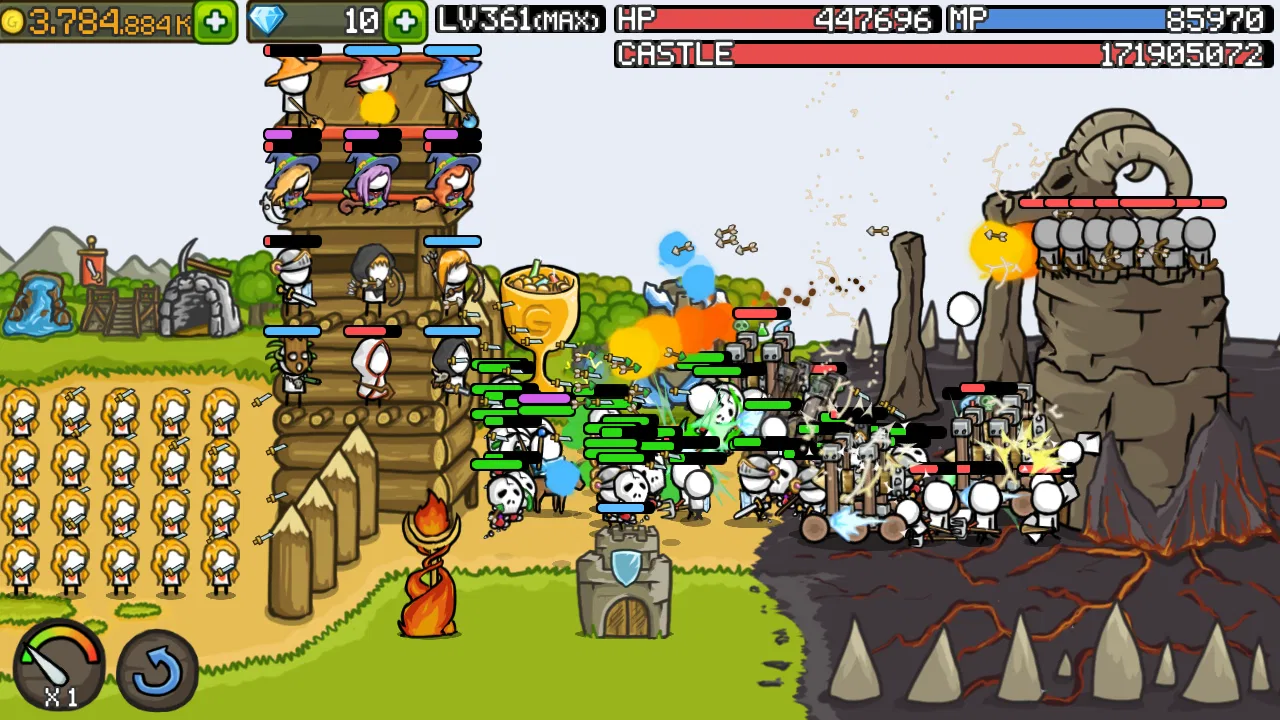
I went into Grow Castle - Tower Defense expecting a quick arcade distraction, but I ended up treating it more like a small routine than a game I finish in one sitting. Its central appeal is easy to understand: you build up a castle, place defenders, improve your forces, and try to hold against increasingly demanding attacks. What makes it stick is the way every short session feeds the next one. I can play actively for a while, leave, return later, and still have a clear reason to make another upgrade.
That loop explains why this free arcade game from RAON GAMES has attracted a large audience. It has an average rating of 4.3 from around 472 thousand ratings, and it has passed 10 million installs. Those figures do not make it automatically perfect, but they do match my experience: the game is approachable within minutes, yet it offers enough decisions to keep a patient player interested.
Why the castle-building loop works so well
The best part of the game is that it does not make tower defense feel like a single repeated gesture. Your castle is not just a background for a battle. It becomes the place where your choices accumulate. The important question is rarely only “Can I survive this wave?” It is also “Which improvement will make the next several waves easier?” That small shift gives ordinary battles a sense of direction.
You May Also Like

 Blood Strike: 2.5 Anniversary
Blood Strike’s Loadouts Turn Every Drop Into a Tactical Gamble
A close look at Blood Strike’s custom loadouts: how fast access to signature weapons reshapes its battle royale rhythm, rewards preparation, and narrows the gap between fights.

 Pandora - Music & Podcasts
Pandora’s Music Is Easy to Start, but Harder to Recover
Pandora’s strength is its low-effort path from a seed to a station. Its weak spot is how much confidence it asks you to place in connection, setup, and quiet recovery.

 8 Ball Pool
 Is Built on Rivalries, Rematches, and Routine
A close look at the rivalries, rematches, shared routines, and unanswered safety questions that turn a quick pool match into a persistent mobile community.

 Samsung Music
’s Quiet Strength Is Playing What You Already Own
Its reach comes less from spectacle than from dependable access to a personal library. That simplicity is both the app’s strongest retention engine and its ceiling.

 AccuWeather: Weather Radar
AccuWeather Review: A Quick, Clear Forecast for Everyday Decisions
For everyday plans, the best forecast is the one you can understand quickly. AccuWeather makes rain timing, radar, and local conditions easy to act on, with a few trade-offs.

 Hill Climb Racing
Why Hill Climb Racing Still Turns Crashes Into One More Run
A tiny car, a bumpy hill and one more upgrade: Hill Climb Racing keeps resurfacing because its simple chaos makes every near-miss feel personal.
More From Our News Desk



I like this structure because it creates a useful rhythm. A difficult attempt shows me where my defense is weak, a successful run provides resources or progress, and the next visit becomes a chance to correct the problem. The process feels more personal than simply selecting a stage and hoping that a fixed solution works. Even when I lose, I usually have a practical idea about what to change.
The castle itself gives the game its identity. Instead of presenting tower defense as a series of disconnected maps, Grow Castle encourages me to think about a growing stronghold. That makes upgrades feel meaningful. A new improvement is not merely a number going up in a menu; it is part of a longer plan for how I want my defense to function.
For a phone game, this is especially effective during short breaks. I can check my setup, play a few rounds, decide whether to invest in a stronger option, and stop without feeling that I have abandoned a complicated campaign. At the same time, the system has enough depth for longer sessions when I want to compare choices and test a more deliberate approach.
Small decisions matter more than fast tapping
One of the more useful lessons I learned is that spending everything immediately is not always the smartest move. When I first played, it was tempting to buy the most obvious improvement as soon as I could afford it. Later, I found more value in pausing to consider whether the upgrade solved my current problem or simply looked attractive. If a defense is failing because enemies are reaching the castle too quickly, increasing a different kind of power may not help as much as improving the part of the setup that controls the approach.
This creates a quiet form of strategy. The game is accessible enough for casual play, but it rewards players who observe the result of each change. I recommend making one meaningful adjustment at a time rather than changing everything between attempts. That way, it is easier to understand which decision actually improved the defense.
Another practical habit is to treat the early waves as testing ground instead of rushing through them mentally. They show whether the current arrangement is balanced or whether it depends too heavily on one strong element. A setup that looks impressive in a comfortable battle can reveal a serious weakness once pressure increases. Watching that transition is more informative than simply chasing the largest visible upgrade.
A good fit for gradual progress
The progression is strongest for people who enjoy games that remember their effort. I do not need to master every mechanic immediately. I can return after a break, make one improvement, and feel that the next attempt is slightly more manageable. This is a better experience for me than a purely reflex-based arcade game where success depends mainly on maintaining perfect concentration.
There is also a satisfying contrast between the simple presentation and the amount of planning underneath it. The game does not need a large narrative to keep me involved. Its story is effectively the history of my castle: what I upgraded, where I struggled, and which approach finally allowed me to move forward. That personal record gives the repeated battles more character than their basic format might suggest.
Still, the gradual design asks for patience. Players who want instant access to the strongest options may find the early development too restrained. The game is built around returning, adjusting, and building over time, not around handing over every possibility at once. I see that as a strength, but only if the player enjoys incremental progress.
Where it differs from familiar tower defense games
Compared with a traditional level-based tower defense game, this one feels less like solving a fixed puzzle and more like maintaining a long-term project. In many alternatives, the main satisfaction comes from finding the correct placement for a particular map. Here, the castle-building layer makes the broader progression just as important as the individual battle.
That makes it more forgiving in one sense. If a stage exposes a weakness, I can often work on the larger development of my castle rather than relying on a single perfect attempt. It also makes failure less final. I am not only replaying the same challenge; I am using the experience to shape a stronger future setup.
The trade-off is that players who prefer tightly designed stages and a clear finish line may find the structure less focused. A conventional tower defense game can offer a cleaner sense of campaign movement, while this one is more comfortable with repetition and ongoing improvement. I would choose Grow Castle when I want a persistent project on my phone, but I would choose a stage-driven alternative when I want a carefully authored sequence of challenges.
What can become frustrating after the first sessions
The same progression that makes the game addictive can also make it feel repetitive. Battles share a familiar basic purpose, and the excitement depends heavily on whether I am currently unlocking a useful improvement or simply repeating a comfortable section. When progress slows, the loop can lose some of its energy. I sometimes found myself playing from habit rather than because the next battle felt especially fresh.
This is the most important limitation to understand before installing it. The game is not designed around a constantly changing stream of surprises. Its pleasure comes from refinement. If you enjoy watching a system grow, that repetition is relaxing. If you need every session to introduce a new setting, mechanic, or dramatic twist, the routine may wear thin.
The free-to-play structure also deserves attention. The game is free to download, with in-app purchases ranging from $2.49 to $83.99 per item. I would approach those purchases carefully. The strongest way to enjoy the game, in my opinion, is to decide whether the normal progression is satisfying before spending anything. A purchase can make progress feel more convenient, but convenience is not the same as learning the defense or making better choices.
That distinction matters because the game’s most rewarding moments come from understanding why a setup succeeds. If spending removes the need to think about upgrades, it can reduce the very decision-making that gives the castle its character. I would not recommend buying anything simply because a difficult wave feels annoying. First, I would change the arrangement, review the weakest part of the defense, and try again with a more focused plan.
How I handle difficult stretches
When progress stalls, I avoid rebuilding the entire castle at once. I first identify the exact point where the defense begins to fail. Is the problem an early leak, a lack of damage later in the attack, or a setup that works only when I am actively managing it? Each issue suggests a different response. This simple diagnosis prevents wasted resources and makes improvement feel deliberate.
I also recommend keeping a little flexibility in your choices. A setup that is excellent against one kind of pressure may not be the best general arrangement. It is tempting to specialize too aggressively after one successful run, but that can make the next challenge unexpectedly awkward. I get better results when I build a reliable foundation first and then add specialized strength where it is genuinely needed.
Players should also be comfortable with the idea that not every battle needs to be conquered immediately. Sometimes the most efficient move is to step away, return later, and use the accumulated progress to make the next attempt less stressful. That is not a failure of skill; it is how the game’s long-term structure is meant to work.
Who will enjoy it most
I would recommend it to someone who likes mobile games that can be played in small pieces but still offer a reason to return. It works particularly well for players who enjoy upgrading a central base, comparing defensive choices, and seeing gradual improvement rather than chasing a short campaign ending.
It is also a good choice for people who prefer strategy with a low barrier to entry. You do not need to learn a complicated control scheme before making progress. The challenge comes from choosing where to invest attention and resources. That makes it suitable for a commute, a waiting room, or a quiet evening when I want something more engaging than a basic time-killer.
A realistic everyday use case is a short break between tasks. I can open the game, check whether my last setup is still effective, play a few attacks, and make one upgrade before returning to work. Later, I can continue from the same point without needing to remember a complicated plot or reconstruct a large map. That convenience is one of its strongest practical qualities.
The Teen content rating is worth keeping in mind for families deciding whether it suits a younger player. I would not choose it solely for a child without checking the device and household expectations first. For older players, the rating is unlikely to be a major obstacle, but it is still useful context when considering who should have access to the game.
Who should probably skip it
I would skip this game if I wanted a purely competitive experience, a story-led adventure, or a tower defense campaign with a clearly defined final chapter. Its appeal is not cinematic presentation or a dramatic narrative. It is the steady satisfaction of strengthening a castle and learning how its defense behaves.
I would also hesitate to recommend it to anyone who dislikes repeated battles or free-to-play economies in principle. Even if the core loop is enjoyable, the long-term format asks the player to tolerate some repetition and to make careful decisions about optional spending. A premium game with a fixed price may be a better fit for someone who wants a more controlled progression path and no purchase prompts.
Likewise, players who prefer immediate action with minimal planning may find the upgrade layer slower than expected. The game looks simple at first, but its best results come from paying attention. If I only tap through battles without considering why the castle is failing, progress becomes less satisfying and more mechanical.
Device expectations and version context
The current version is 1.50.14, and the game supports devices running Android 5.1 or later. That broad compatibility makes it a practical option for people using older Android hardware, although the experience will naturally depend on the condition and performance of the individual device. I would still keep the system updated and make sure there is enough free space before installing any game, especially on an older phone.
Because it is an established release rather than a brand-new experiment, the overall design feels settled. The release date was April 25, 2016, and that long presence helps explain why the game has had time to build such a large player base. It also means I approach it as a mature, familiar arcade title rather than expecting the kind of novelty associated with a new launch.
My final recommendation
After spending time with it, I see Grow Castle as a strong choice for players who want a persistent tower defense routine rather than a one-off burst of action. Its best quality is the connection between each battle and the castle’s broader development. I always have a reason to inspect my choices, adjust a weak point, and try again.
Its weaknesses are equally clear: repetition can become noticeable, progress asks for patience, and the optional purchase range means I would keep a close eye on spending. Those issues do not cancel out the fun, but they define the kind of player who will enjoy it. This is not the right game for someone seeking a tightly scripted campaign or constant novelty.
For me, the verdict is positive with a condition: play it as a gradual strategy project, not as a race to unlock everything. Start free, make changes thoughtfully, and let difficult battles teach you what the castle needs. If that rhythm sounds appealing, this arcade game from RAON GAMES is easy to recommend. If you want a shorter, more polished, level-by-level experience, a conventional tower defense alternative may suit you better.
As a free game, it offers enough room to discover whether its loop fits your habits before you commit money or much time. I would install it for short daily sessions, keep purchases optional, and judge it by how much satisfaction I get from improving my own defense. For the right player, that steady sense of ownership is exactly what makes Grow Castle - Tower Defense worth returning to.
FAQs for Grow Castle - Tower Defense
01What is Grow Castle - Tower Defense?
Grow Castle - Tower Defense is a strategy game in which you defend your castle against waves of approaching enemies. You can place heroes and archers on the castle tower, upgrade their abilities, improve your walls and weapons, and gradually build a stronger defense. Each battle rewards you with resources, making progression feel continuous even when the later stages become challenging.
02Is Grow Castle - Tower Defense free to download and play?
Yes, Grow Castle - Tower Defense can generally be downloaded and played for free on supported Android and iOS devices. The game may include optional advertisements and in-app purchases that provide extra resources or convenience. You can progress without paying, although upgrading heroes, unlocking improvements, and advancing through difficult levels may take more time if you choose not to spend money.
03Does Grow Castle require an internet connection?
Many of the main gameplay features in Grow Castle can be enjoyed without a constant internet connection, which makes it suitable for short sessions while traveling or when mobile data is unavailable. However, certain functions, including advertisements, cloud-related features, updates, or purchase verification, may require internet access. Availability can vary depending on your device and the installed version.
04How does progression and upgrading work in the game?
Progression is based on completing defensive battles, earning gold and other rewards, and investing those resources into your castle, heroes, units, and abilities. Choosing the right combination of defenders is important because different enemies and stages require different strategies. If a level feels too difficult, replaying earlier stages, improving your roster, and changing your formation can make a noticeable difference.
05Is Grow Castle suitable for casual players and children?
Grow Castle is relatively easy to understand because its central goal is simply to defend the castle from enemy waves, but it also includes strategic choices that reward planning. Casual players can enjoy short battles and gradual upgrades, while younger players may need help understanding purchases, advertisements, and resource management. Parents should review the store rating and device settings before allowing in-app purchases.
Pros
- Hundreds of heroes and units offer plenty of team-building variety.
- Offline play makes it convenient for commutes or areas without internet.
- Frequent upgrades create a satisfying sense of long-term progression.
- Simple controls make battles easy to understand on smaller screens.
- Pixel-art visuals give the game a charming retro personality.
Cons
- Later stages can feel repetitive despite the large amount of content.
- Some upgrades require substantial grinding or repeated battle runs.
- The interface may feel crowded when managing many heroes and features.
- Difficulty spikes can make progress frustrating without careful strategy.
- Ads and in-app purchases may interrupt the otherwise enjoyable experience.

Grow Castle - Tower Defense
Gallery